Caffeine · The Morning Cup
The 2 p.m. Crash Is a Clock Problem, Not a Coffee Problem
Caffeine leaves the body on a schedule you can calculate. Once you can, the afternoon slump stops being a mystery and starts being arithmetic.
Seven in the morning, first cup. Nine thirty, the second one, because the first one stopped working. Two in the afternoon, the wall shows up anyway, and the obvious move is a third cup that you will still be carrying at eleven tonight.
Most people file this under coffee stopped working for me. It is closer to a scheduling error. Caffeine leaves the body on a curve, that curve is published, and once you can read it, almost every complaint in the paragraph above stops being mysterious.
None of what follows is a claim about a brand. It is arithmetic on two numbers that anyone can look up, and the arithmetic happens to explain why one of the more disciplined coffee companies in the United States has been running an ad that says, word for word, No Jitters. No Crash. Just Coffee.
OneYour cup is not adding anything
The first thing to get straight is that caffeine does not hand out energy. It takes the seat where the tiredness signal sits.
Adenosine is the molecule that accumulates while you are awake and tells the brain, politely at first, that it is time to stop. Caffeine is shaped closely enough to sit in the same receptor without triggering it. The message keeps arriving. Nobody is answering the door.
That single fact reframes the whole day. A cup of coffee is not a deposit into an account. It is a hold placed on a message. When the hold weakens, the message gets delivered, all of it, on time.
TwoFive hours, then five more
Here is the number that runs the rest of your day, and almost nobody knows it.
Five hours to lose half. Then five more to lose half of what is left. Caffeine has, in the same source's words, nearly 100% oral bioavailability, which means essentially all of what is in the cup gets in. From there it is pure decay.
Run those two numbers against a clock and the famous morning cup looks like this.
| Time | Still on board | Share of the original dose |
|---|---|---|
| 7:00 a.m. | 95 mg | |
| 9:30 a.m. | 67 mg | |
| 12:00 noon | 47 mg | |
| 2:00 p.m. | 36 mg | |
| 5:00 p.m. | 24 mg | |
| 8:00 p.m. | 16 mg | |
| 11:00 p.m. | 10 mg |
Read the two shaded rows again. At noon, half of the 7 a.m. cup is still working. At two in the afternoon, when the wall arrives, there is still about a third of it on board.
So the 2 p.m. slump is not the coffee failing. It is the back half of the morning dose leaving on schedule, exactly when it was always going to leave, while the tiredness that has been queuing outside the door all morning finally gets in. The cup did its job. The clock did the rest.
ThreeWhere the jitters actually come from
Jitters get blamed on bad coffee, cheap beans, acidity, mold, the roast. Regulators are blunter about it. The Food and Drug Administration lists jitters plainly, alongside insomnia, anxiety and heart palpitations, under the heading Signs of Consuming Too Much Caffeine. Not signs of the wrong coffee. Signs of too much.
And the agency puts a number on too much.
Put the two published figures side by side and the day gets a budget. At about 95 mg a cup, the FDA's ceiling sits a little over four cups.
That is a useful reframe, and it is also where most people stop reading, congratulate themselves for being under the limit, and go on sleeping badly. Because the daily total is the easy half of the problem.
The part the limit hides
Three cups spread across a working day comes to roughly 285 mg. Comfortably under 400. On paper, a well-behaved day.
The FDA's figure is a total, and a total has no clock in it. Two people can drink exactly the same 285 mg and go to bed in completely different states. What separates them is nothing but the hour on each cup.

FourThe 2 p.m. cup is borrowed from tonight
The afternoon cup is the one that feels free. It is the expensive one.
Sleep researchers gave healthy adults 400 mg of caffeine at three different distances from bedtime. Even the most innocent-looking condition, a full six hours before lights out, did measurable damage.
Drake and colleagues, Journal of Clinical Sleep Medicine, 2013. The 6 hour recommendation is the one cited in StatPearls, drawn from a systematic study.
Now put the whole thing on one chart. Same drinks, same milligrams, only the hours differ.
Which closes the loop, and the loop is the actual product being sold to you every afternoon by every energy brand on earth. The 2 p.m. cup buys back the afternoon and bills the night. The night comes up short. Tomorrow starts tireder, so tomorrow needs a bigger morning. Repeat for years.
This is why no crash is a strange promise to argue with on the merits of a bean. The crash is not a defect in the coffee. It is the shape of the curve.
FiveThe three things you can actually move
Given all of the above, there are exactly three variables in your control, and most people only ever touch the first one.
- How much. Total milligrams against the FDA's 400. The easiest to count, and usually not where the problem is.
- What time. The single most powerful lever on the list, and the one nobody schedules. A cup at 3 p.m. is still one third alive at 11.
- What is in the cup. The one almost nobody has ever deliberately changed.
That third one is worth a paragraph, because it is where this particular company built an entire business, and because there is a published fact underneath it that has nothing to do with marketing.
Ten words, and they describe the difference between coffee taken on an empty stomach at 7 a.m. and coffee taken with something in it. The dose does not change. The way it arrives does.

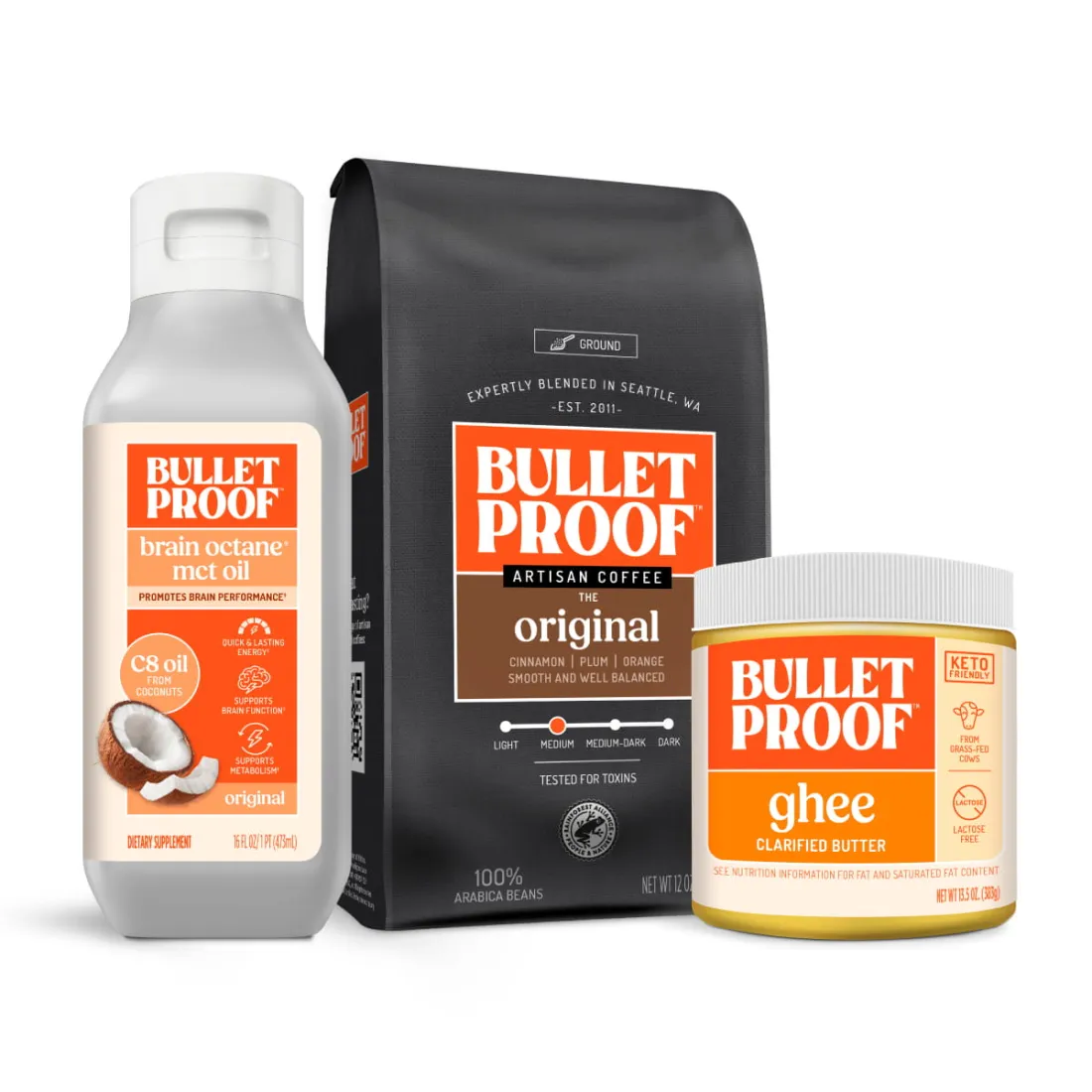
The original recipe, as they publish it
- Brew 1 cup, 8 to 12 ounces, using their coffee.
- Add C8 MCT oil and grass-fed ghee to a blender.
- Blend 20 to 30 seconds, until it looks like a creamy latte.
That is the whole thing. Their own instructions tell newcomers to start with a teaspoon of the oil and build up to the full serving over several days, which is not the usual direction of travel in this category.
We are deliberately not going to tell you what that will do for you. Nobody honest can, and their own site carries the standard disclaimer saying these products are not intended to diagnose, treat, cure or prevent any disease. What is documented is narrower and more useful: caffeine on its own is absorbed fast and nearly completely, and caffeine taken with food is absorbed a little more slowly. If your complaint is the shape of the morning rather than the quantity of it, that is the variable you have never tried.
SixWho this does not work for
A page like this one usually ends by telling everybody that the answer is to buy something. Here is the honest version instead. There are several people for whom changing coffee will do precisely nothing, and it is worth checking whether you are one of them before you spend twenty dollars.
Skip this if
- You are already well past 400 mg a day. That is a quantity problem. No roast on earth solves a quantity problem, and the FDA lists jitters, palpitations and insomnia as what it looks like.
- Your last cup is after 3 p.m. Then the hour is your problem, not the bean, and moving it is free. Fix that first and see what is left to complain about.
- You smoke. Smokers clear caffeine up to twice as fast, so your curve is not the one on this page, and your 2 p.m. is genuinely emptier than everyone else's.
- You have liver disease, or take medication that slows the CYP1A2 enzyme. Then caffeine hangs around considerably longer than five hours and this is a conversation for your doctor, not a coffee article.
- You are thinking of quitting outright. Withdrawal typically starts 12 to 24 hours after the last dose, peaks over one to two days and can run a week. Tapering avoids it. Stopping on a Monday does not.
One more, because it catches people every year: decaf is not zero. The FDA puts a decaffeinated cup at 2 to 15 mg. Small, but not nothing, and if you are the kind of person who can feel a square of dark chocolate at 9 p.m., that range matters to you.
SevenWhat is actually in the bag
Which leaves the narrow, checkable question. If you are going to keep drinking one or two cups in the first half of the day, and you would like them to be good, what is this particular coffee.

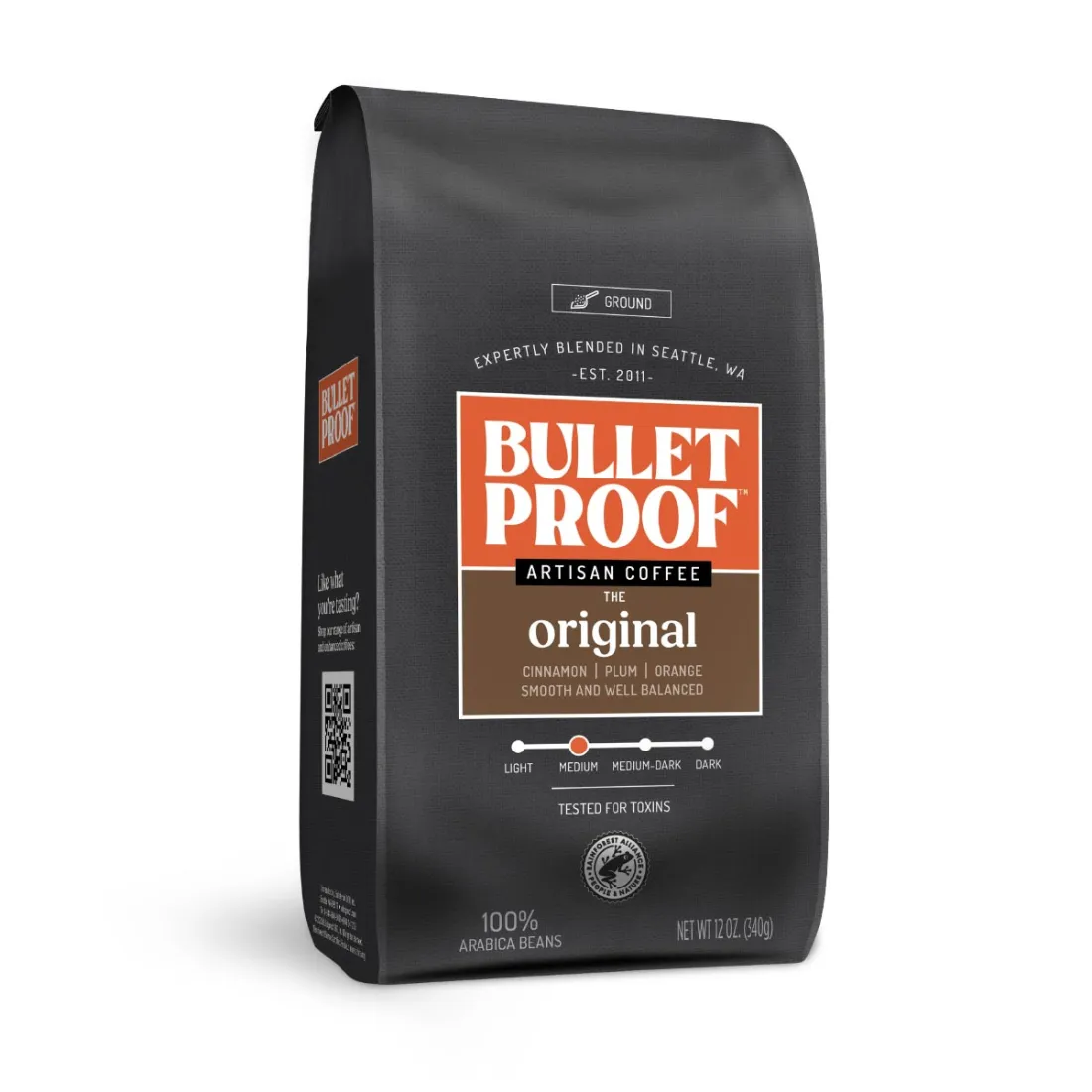
It is a medium roast. The brand's own product description lists notes of cinnamon, plum and orange with a cocoa hazelnut finish, and states that because packaged coffees can contain mold toxins, every batch of beans is tested for them. That is a sourcing and quality-control claim about the bag, which is a very different kind of claim from a promise about your afternoon, and it is the kind you can actually hold a company to.

Brewing instructions, in their words: two and a half tablespoons of ground coffee for every 8 ounces of filtered water. About 95 mg of caffeine in the cup that comes out.

What buyers say, in their own words
These are pulled verbatim from the reviews published on the product page, which currently averages 4.8 out of 5 across 1,905 of them. The third one is on the nose for everything above.
“Best taste ever, and the nice thing about Bulletproof is that I don't feel like I need to drink it all morning to keep going. . . . usually just one cup except for holiday or weekend, but never more than two! This is magic stuff!”
John T., August 9, 2026
“Great taste at a better price.”
Mary V., August 9, 2026
“Good flavor not strong enough for me”
Brian D., July 31, 2026. Included because it is the fair warning: a medium roast tastes like a medium roast.

$19.9912 oz ground · Original medium roast
- About 95 mg of caffeine per cup, published by the brand, which is what lets you plan the day above.
- Every batch tested for mold toxins, per their product page.
- Free shipping over $49. Money back within 30 days if you do not get on with it.
Goes straight to their own product page. Prices and stock are theirs, and current as of August 14, 2026.
And if none of the above changed your mind, the free part of this article still stands on its own: move your last cup earlier by two hours and read the chart again. That one costs nothing.
Sources
- Caffeine content per cup, tasting notes, roast level, batch testing for mold toxins, brewing ratio, price, rating, review count and customer reviews: Bulletproof Original Ground Coffee product page, read August 14, 2026.
- The original recipe, its steps and its stated origin: The Official Bulletproof Coffee Recipe.
- Half-life of roughly 5 hours, adenosine receptor antagonism, near-complete oral bioavailability, delayed absorption with food, CYP1A2 metabolism, faster clearance in smokers, withdrawal timing and the 6 hour pre-bedtime guidance: StatPearls, Caffeine, National Library of Medicine.
- The 400 mg a day figure, the wide variation between people, the list of signs of too much caffeine and the decaf range: U.S. Food and Drug Administration, Spilling the Beans: How Much Caffeine is Too Much?
- 41 minutes of sleep lost from 400 mg taken 6 hours before bed: Drake C. et al., Caffeine Effects on Sleep Taken 0, 3, or 6 Hours before Going to Bed, Journal of Clinical Sleep Medicine, 2013.
- All decay figures and both charts are computed from a 5 hour half-life applied to a 95 mg dose. They are arithmetic, not measurements of any individual.
This article does not diagnose, treat or prevent anything, and nothing here is medical advice. Caffeine tolerance varies widely between people. If you have a heart condition, a liver condition, or take prescription medication, talk to your doctor before changing your intake.